
A few years ago, “organic spices” was a niche term you’d hear at a farmers’ market or read on a wellness blog. Today it’s showing up in grocery apps, on supermarket shelves, and in WhatsApp forwards from your health-conscious cousin. Something has genuinely shifted in how Indians think about the masala dabba.
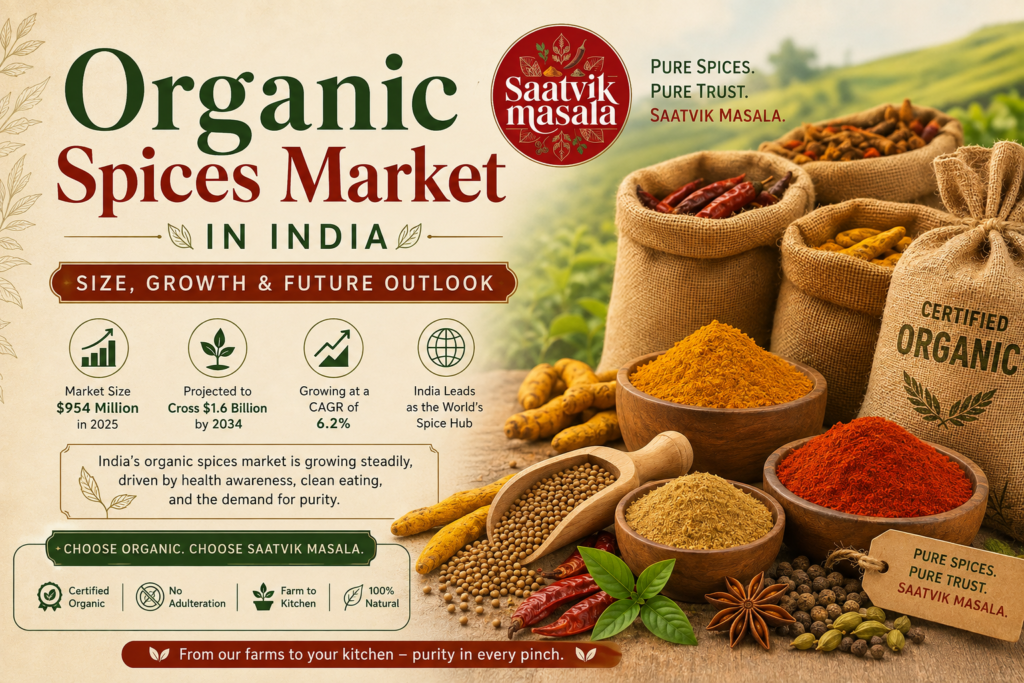
The numbers back this up. India’s organic spices market was valued at roughly $954 million in 2025, and industry estimates put it on track to cross $1.6 billion by 2034, growing at a compound annual rate of around 6.2%. Some research firms peg the number even higher, closer to $1,928 million by 2033. The exact figure depends on who’s counting and how, but the direction is the same everywhere: up, and steadily.
For a country that’s been growing and consuming spices for thousands of years, that’s worth pausing on. What’s actually changing?
It’s not really sudden. It’s been building for a decade, and a few things pushed it into the mainstream.
Health awareness moved from “trend” to “habit.” People aren’t just avoiding junk food anymore — they’re reading labels on their haldi and mirch too. Once someone starts wondering what’s actually in their turmeric powder, there’s usually no going back.
Adulteration scandals did some unintentional marketing. Reports of Sudan dye in chilli powder, lead chromate in turmeric, and sawdust in coriander have made regular appearances in the news over the past few years. Every time one of these stories breaks, organic and certified brands get a small, involuntary boost in trust.
E-commerce made switching easy. A decade ago, buying “pure” spices meant knowing a trustworthy local grinder or trusting whatever your mother-in-law recommended. Now you can compare five organic brands, read reviews, and get a jar delivered in two days. Direct-to-consumer brands have had a lot to do with this shift, since they cut out the layers between farm and kitchen that used to make sourcing opaque.
Turmeric is doing a lot of heavy lifting. India produces about 80% of the world’s turmeric, and curcumin’s anti-inflammatory reputation has turned it into something of a poster child for the whole organic spice category — both domestically and for export.
The demand isn’t limited to metro elites with a wellness budget, though that’s still a strong segment. A few overlapping groups are driving purchases:
If you’re trying to figure out how to actually buy organic spices online without getting fooled by greenwashed packaging, that’s a separate rabbit hole worth reading into. Not everything labeled “organic” or “natural” on a shelf actually is.
It would be dishonest to only talk about growth. A few real obstacles are keeping the organic spice market smaller than it could be.
Price is the biggest one. Organic spices typically cost 20-40% more than regular masala, and for a lot of Indian households — where spices are bought in bulk and used daily — that difference adds up fast. This is probably the single biggest reason the shift is happening gradually rather than overnight.
Home-grinding habits run deep, especially outside metros. In smaller towns and among older generations, buying spices from a trusted local mill or grinding at home is still seen as more reliable than any packet, organic label or not. That’s not irrational — it’s just a different kind of trust, built over generations rather than through certifications.
Certification confusion. FSSAI, India Organic, USDA Organic, Jaivik Bharat — most consumers can’t tell these apart, and some brands lean on vague words like “natural” or “pure” without any real certification behind them. Until labeling becomes clearer, a chunk of genuinely organic brands will keep losing ground to companies that are just better at marketing the word “organic,” whether they’ve earned it or not.
If you’re reading this because you’re trying to decide whether switching to organic spices is worth it for your family, here’s the honest version: it’s not a magic health switch, but it does solve a real problem — knowing what’s actually in your food. Regular commercial spice powders, especially unbranded or loose ones, carry a documented risk of adulteration with dyes, fillers, and in some cases heavy metals. Organic, certified spices remove a lot of that uncertainty, even if they cost more.
You also don’t have to switch everything at once. Most people who’ve made the change started with just haldi or lal mirch powder — the two spices most commonly found to be adulterated — before moving the rest of their kitchen over.
For anyone building a spice brand right now, and I say this having watched this space closely, the opportunity is real but it’s not easy money. The market is growing, but it’s also getting crowded, and buyers have gotten sharper about spotting brands that slap “organic” on a label without backing it up.
What seems to actually work: real certification, transparent sourcing (where the spice was grown, not just where it was packed), and consistent quality batch after batch. Trust in this category gets built slowly and lost instantly — one bad batch with visible mold or a weird smell, and a customer won’t come back, no matter how good your Instagram page looks.
The CAGR estimates across different research firms cluster between 5% and 7%, which is healthy but not explosive. That tracks with what’s actually happening on the ground — this is a gradual behavior shift, not a fad. Bulk food processing companies, export demand, and quick-commerce grocery apps are all likely to keep pushing volumes up over the next few years, alongside individual households making the switch one jar at a time.
If anything, India is well positioned to lead this category globally. It’s already the world’s largest producer, consumer, and exporter of spices. The infrastructure and farming base already exist — what’s catching up is trust, certification, and consumer education.
That last part is really what brands like Saatvik Masala are betting on: not chasing a trend, but building the kind of transparency that makes “organic” mean something again.
Looking to make the switch yourself? Start with our range of organic Haldi, Mirch, and Dhaniya — FSSAI certified, no additives, and sourced with full traceability.