
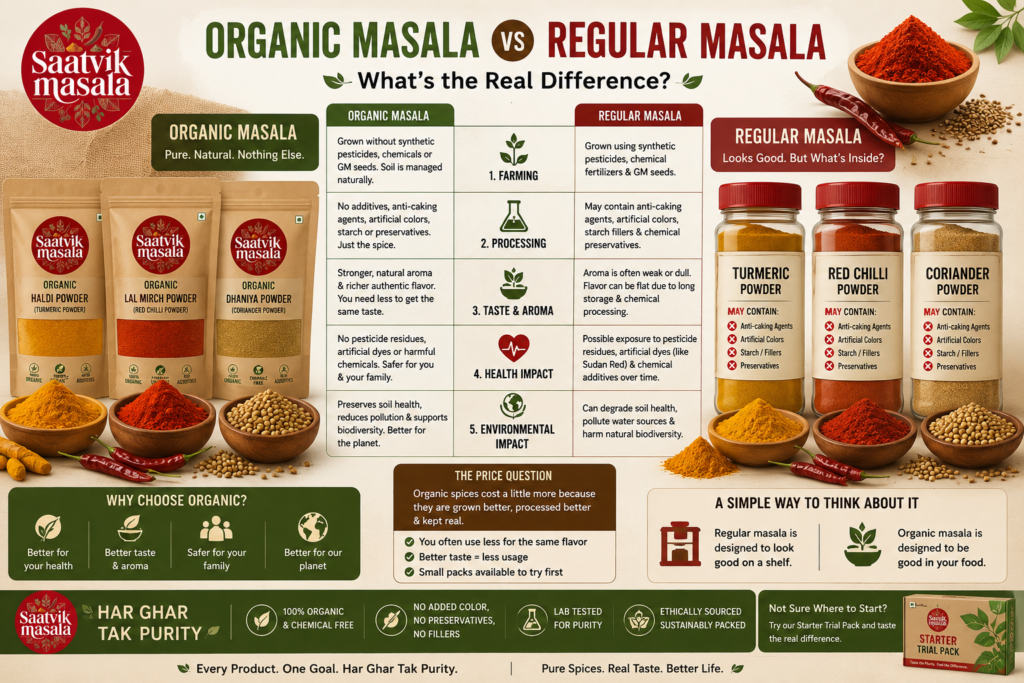
Walk into any Indian kitchen and you’ll find at least three things — a pressure cooker, a box of atta, and a row of masala jars. Spices are so deeply woven into Indian cooking that most of us never stop to question what’s actually inside those jars. But that question is worth asking — because not all masala is the same, and the difference between organic and regular masala goes well beyond the label.
This post breaks it down clearly, so you can make an informed choice for your family.
Before comparing, it helps to understand what organic actually means in the context of spices.
Organic spices are grown without synthetic pesticides, artificial fertilizers, or genetically modified seeds. They are processed without chemical preservatives or anti-caking agents, and they are packaged without artificial colors or flavor enhancers. In India, certified organic products must meet standards set under the National Programme for Organic Production (NPOP).
Regular or conventional spices, on the other hand, are grown using modern industrial farming methods — which often involve synthetic pesticide sprays, chemical fumigants during storage, and various additives during processing to improve shelf life and appearance.
This is where the biggest difference begins — long before the spice reaches your kitchen.
Conventional spice farming often relies on synthetic pesticides and fertilizers to maximize yield. These chemicals can leave residues on the raw spice that carry through to the final powder. Organic farming avoids all of this. The soil is managed naturally, the plants grow at their own pace, and no synthetic chemicals are used at any stage.
The result is a spice that is cleaner at the source — before processing even begins.
Regular masala powders often contain additives that most consumers are unaware of. Common ones include anti-caking agents to prevent clumping, artificial colors to make the powder look more vibrant, starch fillers to increase weight, and chemical preservatives to extend shelf life.
Organic masala contains none of these. What you see in the jar is what it says on the label — the spice, and nothing else. At Saatvik Masala, for instance, the ingredient list for every product is exactly one item long — the spice itself.
This is the difference that most people notice first, and it’s the most convincing argument for organic.
Freshly ground, chemical-free spices have a noticeably stronger and more natural aroma. The flavor is deeper and more authentic — closer to what home-ground spices used to taste like before mass production took over. Conventional spices, especially those that have been sitting in supply chains for months, often taste flat or muted by comparison.
Many home cooks who switch to organic spices report that they use less masala to achieve the same depth of flavor — which effectively offsets the slightly higher cost.
This is where the difference matters most for families who cook with these spices every single day.
Conventional spices may carry pesticide residues, artificial dyes, and chemical additives that accumulate in the body over time with repeated daily consumption. Some of these — particularly banned dyes like Sudan Red, which has been found in red chilli powder samples across India — carry serious health risks including increased cancer risk.
Organic spices eliminate this exposure entirely. You are not just buying taste — you are buying the absence of something harmful. For daily cooking ingredients that go into every meal, that distinction carries real weight. You can read more about the risks of artificial color in our earlier post on identifying artificial dye in red chilli powder.
Organic farming preserves soil health, reduces chemical runoff into water sources, and supports natural biodiversity — including pollinators like bees that are essential to food ecosystems. Choosing organic is not just a personal health decision — it is a small but meaningful vote for more sustainable agriculture.
Conventional farming, especially at industrial scale, can degrade soil over time and contribute to chemical pollution of surrounding land and water.
The most common reason people hesitate before switching to organic is price. Organic spices do cost more — and that’s honest. The farming is more labour-intensive, yields are sometimes lower, and the supply chain is more transparent and traceable.
But the cost difference is smaller than most people assume, especially when you factor in:
Regular masala is designed to look good on a shelf. Organic masala is designed to be good in your food.
The difference is not always visible — which is exactly why it matters. What goes into your masala affects what goes into every meal you cook, every day, for your entire family. That’s not a small thing.
Switching to organic masala is not about following a trend. It is about understanding what you are actually putting into your food and making a deliberate choice about it.
If you have been curious but unsure where to start, the simplest thing to do is try. Compare the aroma when you open the pack. Taste the difference in a simple dal or sabzi. Let the food speak for itself.
At Saatvik Masala, every product — our Organic Haldi, Organic Lal Mirch, and Organic Dhaniya — is grown, ground, and packed with one goal: Har Ghar Tak Purity.