
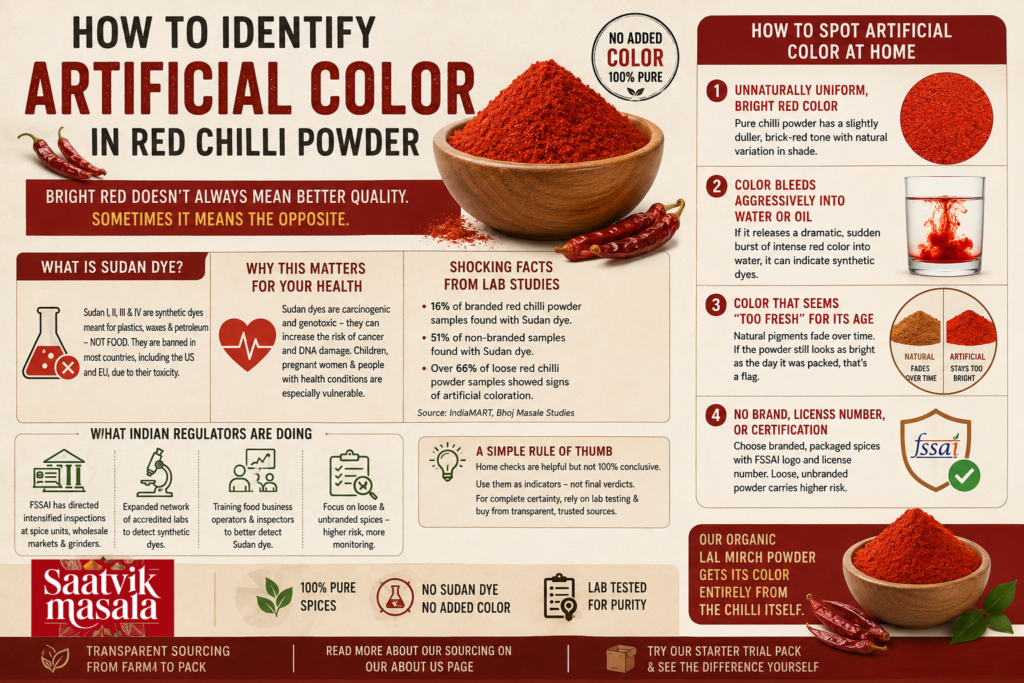
If you’ve ever wondered why some red chilli powder looks almost unnaturally bright red, there’s a reason worth knowing about. Across India, lab studies have repeatedly found a banned industrial dye — known as Sudan dye — used to make low-quality chilli powder look more vibrant than it actually is.
This isn’t a rare, isolated issue. A study analyzing branded and non-branded chilli powder samples from across India found that banned Sudan dye was present in 16% of branded samples and 51% of non-branded samples tested. Another monitoring study of loose chilli powder found the numbers even higher — out of 800 non-branded chilli powder samples tested, over 66% showed signs of artificial coloration.
Sudan I, II, III, and IV are synthetic dyes originally developed for coloring products like plastics, waxes, and petroleum — not food. They’re banned for use in food in most countries, including the United States and the European Union, because of their toxicity.
So why does it end up in chilli powder? High-quality chillies naturally have a bright red color, and chillies that look dull, orange, or yellow tend to fetch lower prices in the market. Adding a cheap industrial dye is a shortcut to make a lower-grade or older batch look fresh and premium — without actually improving the quality.
This isn’t just a quality issue — it’s a health one. Sudan dyes are classified as carcinogenic and genotoxic, meaning they can increase the risk of cancer and DNA damage, with children, pregnant women, and people with existing health conditions being especially vulnerable.
What makes this more concerning is that adulteration risks tend to be higher in loose, unbranded turmeric and chilli powder sold at the retail level, even though most recent detections have been in export consignments. In other words, the loose chilli powder sold in the open at some local markets may carry a higher risk than properly packaged, branded products.
While lab testing is the only way to be 100% certain, there are a few practical signs you can watch for:
Pure chilli powder typically has a slightly duller, brick-red tone with natural variation in shade. If the color looks unusually bright, glossy, or perfectly uniform across the entire batch, that’s worth questioning.
When natural chilli powder is mixed into water or hot oil, the color disperses gradually. If chilli powder releases a dramatic, sudden burst of intense red color into water, it can indicate the presence of synthetic dyes. Pure spices generally show softer, more gradual color release because their pigments come from natural compounds like capsanthin.
Natural pigments fade over time. If a powder that should be a few months old still looks as bright as the day it was packed, that consistency itself can be a flag.
Choosing branded, packaged spices with the FSSAI logo and a clear license number is one of the most effective safeguards, since these products are more likely to be tested and certified. Loose, unbranded powder sold without any traceability carries significantly higher risk.
It’s worth knowing that this issue hasn’t gone unnoticed. The Food Safety and Standards Authority of India (FSSAI) has directed state food safety commissioners to intensify inspections at spice grinding units, processing facilities, and wholesale markets — particularly those supplying loose and unbranded chilli and turmeric powder. FSSAI has also expanded its network of accredited laboratories and is training food business operators and inspectors to better detect synthetic dyes like Sudan dye.
This is encouraging, but enforcement takes time — and until then, the responsibility of checking what you buy largely falls on the consumer.
None of these home checks can replace certified lab testing, but together they offer a reasonable first impression. Colour change should be treated as one indicator among several — not a final verdict — and ideally paired with other checks or, for complete certainty, verified through proper lab testing.
When in doubt, the safest approach is choosing spices from a source that’s transparent about where the chilli is grown, how it’s processed, and whether it’s been tested — rather than relying on color alone.
Bright red doesn’t always mean better quality — sometimes it means the opposite. Understanding why and how artificial color ends up in chilli powder is the first step to making safer choices for your kitchen.
At Saatvik Masala, our Organic Lal Mirch Powder gets its color entirely from the chilli itself — no Sudan dye, no added colorants. You can read more about how we source our spices on our About Us page, or start with our Starter Trial Pack to see the difference for yourself.